You've probably forwarded your calls before. Maybe on vacation, maybe when you switched phones for a day.
But there's a version of call forwarding that most business owners don't know about. It's called conditional call forwarding, and using the wrong type could mean you never see your own calls again — or worse, every unanswered call disappears into a voicemail nobody checks.
The difference between these two is the difference between handing off your phone and having a safety net. If you run a business that depends on answering calls, this matters more than you think.
What is call forwarding?
Standard call forwarding — technically called unconditional call forwarding — sends every incoming call to a different number. Immediately. No ringing. Your phone is completely out of the loop.
When you turn it on:
- Your phone never rings
- Every call goes straight to the forwarding number
- You won't see missed calls, because your phone never knew they happened
- It stays on until you manually turn it off
This is useful in narrow situations. You're on a two-week vacation and want your partner to handle everything. You're switching devices for a day. You've fully handed off call duties to someone else.
But for a business owner who still wants to talk to their own customers? It's the wrong tool.
What is conditional call forwarding?
Conditional call forwarding is smarter. Instead of forwarding everything, it only kicks in when you can't take the call. Your phone rings first. You get the first shot. If you can't answer, the call goes to your forwarding number.
There are three conditions:
When you're busy — you're already on another call. The second caller gets forwarded instead of hearing a busy signal.
When you don't answer — your phone rings for a set number of seconds (usually 20-25, about 4-5 rings), and you don't pick up. Maybe you're on a ladder. Maybe you're driving. The call forwards automatically.
When you're unreachable — your phone is off, dead, or has no signal. The network knows you can't be reached and forwards the call immediately.
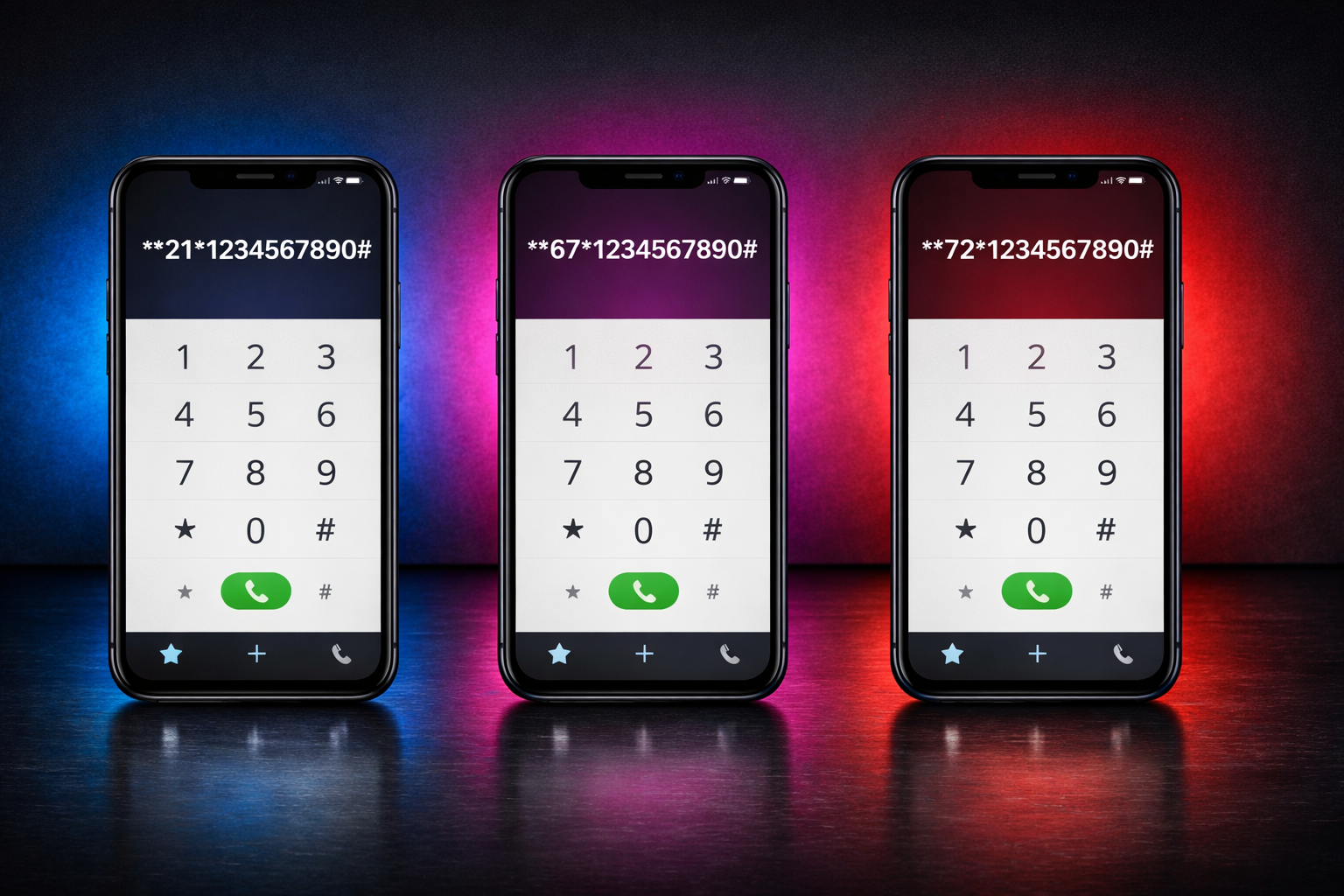
You can set up all three conditions at once with a single code from your phone's dialer. It takes about two minutes. Use our Call Forwarding Setup Tool to get the exact code for your carrier.
The critical difference
Here's the simplest way to think about it:
| Unconditional | Conditional | |
|---|---|---|
| Your phone rings | Never | Always first |
| You can answer calls yourself | No | Yes |
| Forwarding kicks in | Immediately, every call | Only when you can't answer |
| You stay in the loop | No | Yes |
| Best for | Full handoff | Overflow / backup |
Unconditional forwarding says: "I'm done. Send everything somewhere else."
Conditional forwarding says: "I'll handle what I can. Catch what I miss."
For almost every business owner, conditional is the right choice. You want to be available to your customers. You just need a safety net for the calls you physically can't answer.
And if you're in the trades — HVAC, plumbing, electrical, roofing — you physically can't answer a lot of them. You're doing the work. That's the whole point.
Why this matters: the calls you're missing right now
Here's what happens today when you miss a call and don't have conditional forwarding set up:
- Customer calls
- Your phone rings. You can't answer.
- It goes to voicemail
- Customer hangs up (62% of callers don't leave voicemails)
- Customer calls the next business on the list
- You never know they called
That's not a slow day. That's how most missed calls end. Silently. No notification that says "you just lost a $1,200 job." It just doesn't show up.
We've written about this before — the math gets uncomfortable fast. A typical trades business missing 30% of calls loses $80,000+ per year in revenue they never even knew existed.
Conditional forwarding breaks that cycle. Your phone still rings. You still answer when you can. But when you can't, the call goes somewhere that actually picks up.
Three ways to set up your calls with Yadalog
There's no single right answer here. It depends on how you run your business. Here are the three setups we see work best:
Option A: Use your Yadalog number as your primary business line
The simplest setup. Put the Yadalog number on your website, your trucks, your business cards. Every call goes to Yadalog first. The AI answers, qualifies the caller, and books appointments directly into your schedule.
Best for: owners who want every call handled consistently, or businesses running ads where call volume is high and unpredictable.
Option B: Keep your number, add conditional forwarding
You keep your existing business number. You set up conditional forwarding so that calls you can't take get forwarded to your Yadalog number. Your phone rings first — you answer when you can. Yadalog catches the rest.
Best for: owners who want to stay hands-on with their best customers but need a reliable backup. This is the most popular setup.
Set this up in two minutes with our Call Forwarding Setup Tool — just pick your carrier and we'll generate the exact dial codes.
Option C: Both
Use the Yadalog number on marketing materials, ads, and your website. Set up conditional forwarding on your personal line for existing clients and referrals. You get full coverage on the marketing side and a safety net on the personal side.
Best for: owners who separate their marketing number from their personal business line.
"But what about my voicemail?"
This is the number one question we hear. And the answer might surprise you.
Your carrier's voicemail is conditional call forwarding. Right now, when you don't answer, your carrier forwards the call to their voicemail system. That's all voicemail is — a conditional forward to a phone number you don't control.
The problem is that voicemail is a dead end. The caller leaves a message (if they bother — most don't). You listen to it hours later. By then, they've already called someone else.
When you set up conditional forwarding to Yadalog, you're replacing that dead end with a live AI agent that:
- Answers immediately, in a natural voice
- Asks the right questions to qualify the lead
- Books the appointment into your calendar or dispatch software
- Sends you a summary with full context
Same forwarding mechanism. Completely different outcome.
You're not losing voicemail. You're upgrading it.
How to set it up
Setting up conditional forwarding takes about two minutes. You don't need to call your carrier. You don't need to install anything. You just dial a code from your phone.
The code is different depending on your carrier (AT&T, T-Mobile, Verizon, and all their sub-brands like Cricket, Mint, Metro, etc.), but the process is the same:
- Open your phone's dialer
- Enter the activation code with your Yadalog forwarding number
- Tap Call
- Done
We built a free Call Forwarding Setup Tool that generates the exact code for your specific carrier. Pick your provider from the list, enter your Yadalog number, and you'll get a one-tap dial link that does everything for you.
If you're not a Yadalog customer yet and want to see how the AI agent handles calls before you set anything up — talk to our AI and hear it for yourself.
The bottom line
The difference between call forwarding and conditional call forwarding is the difference between checking out and having backup.
Unconditional forwarding removes you from the equation. Conditional forwarding keeps you in it — and makes sure nothing falls through when you're busy doing the work your customers are paying you for.
If you're running a business where missed calls cost real money, conditional forwarding isn't optional. It's the simplest thing you can do today to stop losing jobs you never knew about.
Set up conditional forwarding now — free tool, 2 minutes, any carrier.